

Sarah Mills: Justin Timberlake's arrest video should be made public
Justin Timberlake is fighting in court to keep his impaired driving arrest video hidden. Sarah Mills says the multi-mill...
It happens all the time.
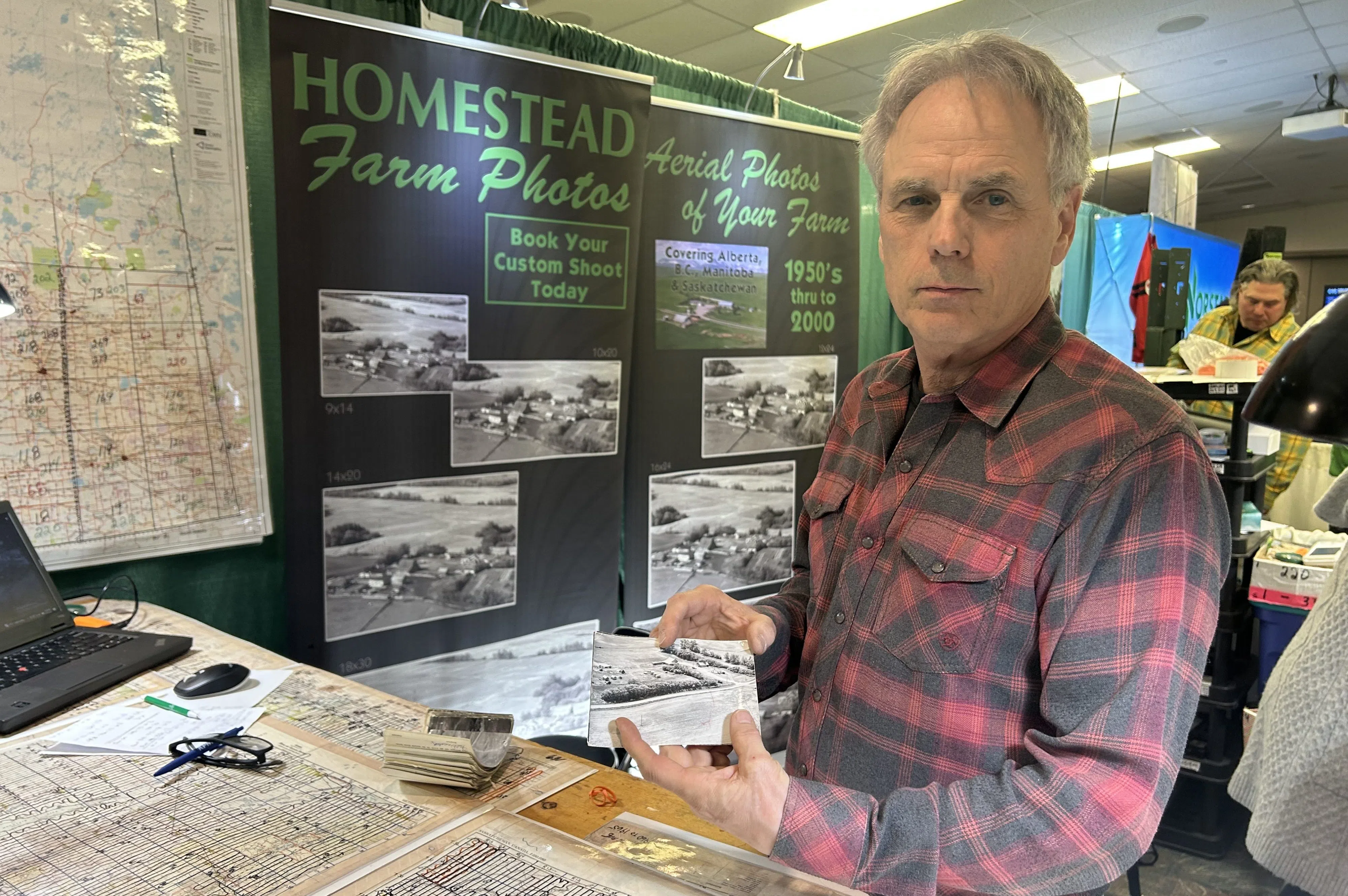
Someone steps up to the Homestead Aerial Photos booth, and a few minutes later they’re staring at a farmyard they haven’t seen in decades.
Read more Saskatchewan Stories from Brittany Caffet:
Sometimes they see themselves standing there in the picture, a small figure frozen mid-stride in the grass.
Sometimes it’s their parents. Grandparents. A horse they thought they’d never see again.
That’s when the Kleenex comes out.
Kim Bessette has watched it happen over and over again. Now based in Calgary, Bessette grew up north of Humboldt near St. Benedict, and his wife is from the Mankota area.
Together, they run a business built on preserving aerial images of prairie farmyards, many of them taken more than half a century ago.
This week at the Western Canadian Crop Production Show in Saskatoon, those memories are coming back into focus.
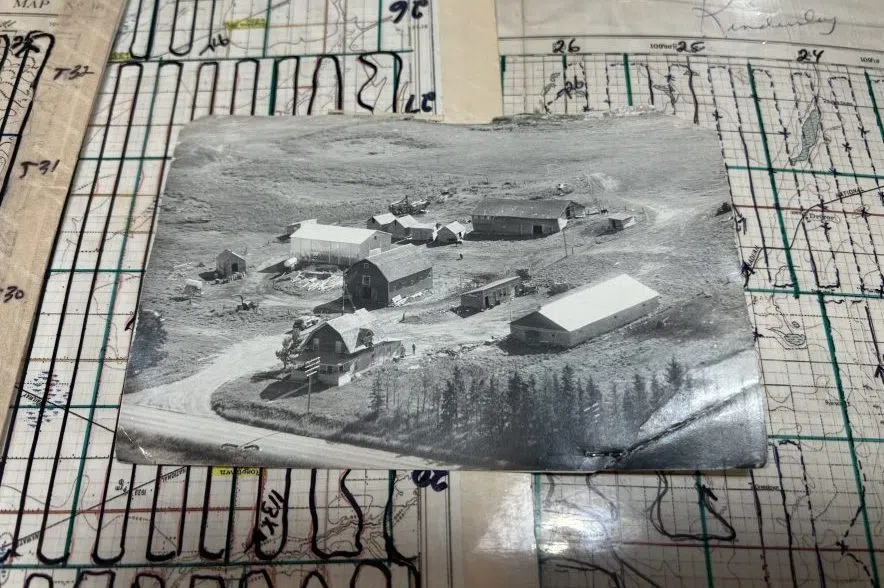
It’s more than a photo. It’s a moment in history, frozen in time. Aerial photos often capture people who are long gone standing out in the yards they tended to. (Brittany Caffet/650 CKOM)
The company’s archive stretches all the way back to 1953, when aerial photographers began methodically flying grid patterns across Western Canada, photographing every farmyard below.
The result is a remarkable visual record of prairie life — one that allows families to look back across generations.
“We can find photos over the last 60 years,” Bessette explained. “So it brings back a lot of memories and a lot of family heritage.”
Homestead Aerial Photos nearly disappeared once already. In 1993, the man who started the business in 1953, was ready to retire.
Bessette and his wife saw what was at stake. Both came from Saskatchewan farms and they recognized the value of what those negatives held.
They decided to bring the company back to the public, opening the archive and helping people search for their own piece of history.
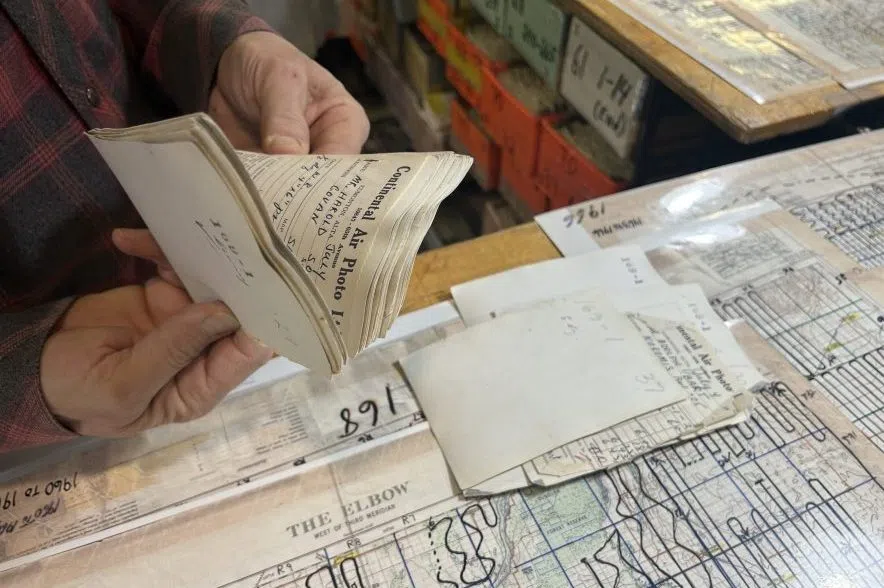
The original bill of sale is attached to the back of many of the prints, a unique glimpse back into the past. (Brittany Caffet/650 CKOM)
Finding the right photo is rarely straightforward. The easiest way is with a legal land location. If that’s not available, directions from the nearest town can help narrow down the correct flight, though it still doesn’t guarantee the exact image.
From there, it often comes down to names — the first and last name of the farm owner — and the decade someone is searching for, whether that’s the 1950s, ’60s or ’70s and beyond.
Once a photo is identified, orders are printed directly from the original negatives before being custom framed. It takes three to four weeks before the finished piece is shipped out.
The original photography was systematic. Each roll of film captured about 40 farms. Each summer, roughly 10,000 farmyards across the prairies were photographed.
In winter, salesmen went from farm to farm trying to sell the photos, which wasn’t an easy job. Road conditions mattered. Crop yields mattered. In lean years, photos were a luxury many couldn’t justify.
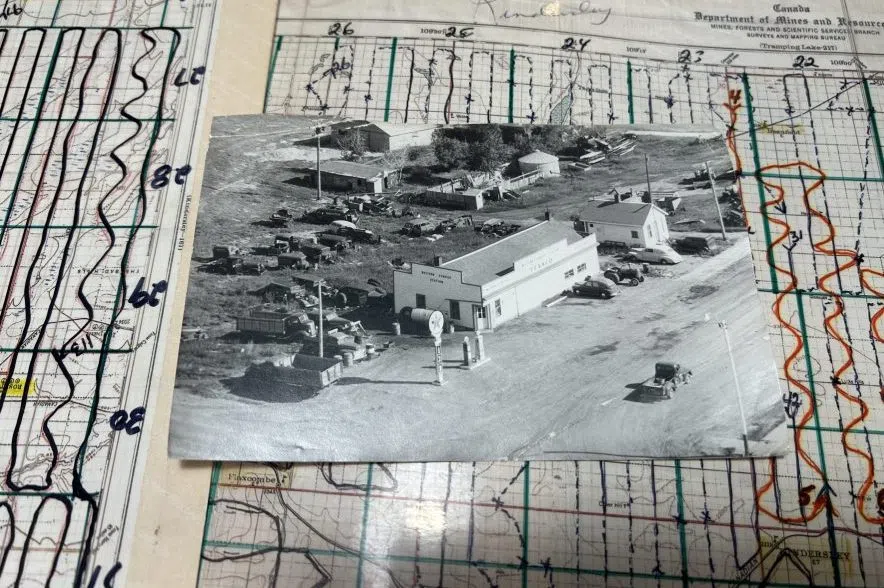
The Homestead Farm Photos archive doesn’t only contain farm photos. Small community businesses, schools and churches were also captured and saved. (Brittany Caffet/650 CKOM)
The older images, especially, are full of detail. Flights in the 1950s were flown low, as there were no airspace restrictions. The cameras captured everyday life as it was happening.
“Lot of kids running out in the yard,” Bessette said. “They might see themselves in the yard, or pictures of grandma, grandpa in the yard.”
Sometimes, it’s even more specific than that.
“A guy today, he saw Deuce,” Bessette noted with a smile. “His favorite horse as a kid growing up.”
Those moments hit people hard.
“It’s very emotional. It brings a lot of joy to them and we go through a lot of boxes of Kleenexes.”
Today, the tools have changed, but the goal hasn’t. Homestead Aerial Photos still takes new aerial images — now using drones, after years of planes and even helium blimps.
They also continue to connect families with the past. Those who can’t attend trade shows can connect with the company online, view images by email and order from home.
In the end, these are far more than just photos.
They’re a way to step back in time and see a place exactly as it once was.
Before buildings moved, before trees grew tall or were cut down, before people left or grew older or were gone.
For a moment, everything is right there again. A farm. A family. A life — frozen in time.