
Murray Wood: We should defend Ukraine because it is the right thing to do.
Four years of Russian barbarism after the invasion of Ukraine seem to have left some Canadians less concerned about that...
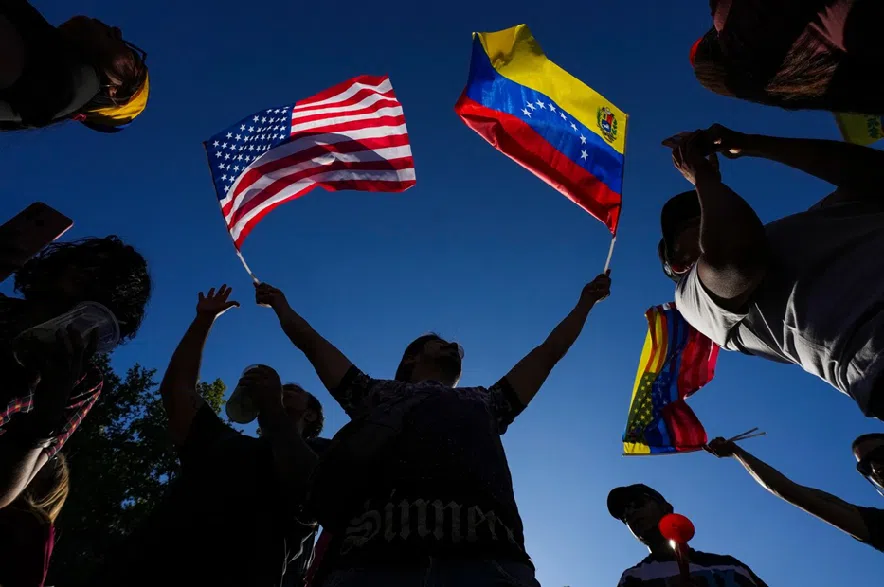
A massive U.S. military operation in Venezuela has left many unanswered questions for people across the globe, with many left wondering if the operation was even legal.
In the late hours of Jan. 2 and early hours of Jan. 3, the U.S. military conducted a massive operation in the country, resulting in the capture and arrest of Venezuelan President Nicolas Maduro and his wife, Cilia Flores.
Read more:
The joint operation included U.S. Army, Navy, Air Force, and Marines, as well as intelligence and law enforcement groups, such as the CIA and DEA.
Nations around the globe have begun to question the legality of the operation and whether the Trump administration had broken international law in arresting Maduro.
Jeremy Paul is a professor specializing in constitutional law at Northeastern University in Boston, Massachusetts, and he recently joined The Evan Bray Show to discuss the operation.
Following the operation, the Trump administration held a news conference where it claimed that the point of the operation was to apprehend Maduro and bring him to the U.S. to hold him accountable for multiple charges, including drug trafficking and conspiracy to commit drug trafficking, which they said justified the U.S. use of the military.
According to Paul, U.S. President Donald Trump’s comments in that news conference may cause legal hurdles.
“He describes a completely different set of rationales, which included comments about how our country (the U.S.) is going to now run Venezuela. If we’re running Venezuela, that completely undermines the rationale that merely all we were doing was apprehending Maduro,” he said.
“We’ve got him now. He’s in custody in New York. He’s about to go on trial, and that would be the end of it and we would just go away because we’ve accomplished the mission. So I don’t know what the rationale is for the second part. So far, they haven’t really identified one.”
Paul also stated that framing the mission as a law enforcement operation opens up another legal can of worms.
“The challenge is that if you really are required to use the military in order to accomplish such a mission, you’re basically giving our prosecutors and our grand juries the power, by indicting someone, to declare war on another country,” he said.
The Trump administration also wasn’t given approval for the operation by Congress, but Paul says this is becoming more and more common with every new administration.
“In the case of Iraq, President George W. Bush did get congressional authorization for that,” he said.
“But the closest precedent to what happened with Maduro is the seizure of Manuel Noriega in Panama in 1990 by the first President Bush. It was not the same as here, people were shooting at our forces, and we had the Panama Canal there, and that made that different as well, but that’s the closest,” said Paul.
“Here’s the problem, in contemporary warfare sometimes you have to act fast and you can’t wait to get congressional approval, and everybody understands that,” he said.
“For example, when President Obama seized and ultimately killed Osama bin Laden, you don’t want him to wait around for congressional approval to do something like that, and those things like that happen a lot, so presidents of both parties have done that,” he said.
“But this is a little different because the law enforcement rationale is a different rationale from the one that you’ve seen in all those other presidential cases,” said Paul.
On Jan. 5, the UN Security Council held an emergency meeting discussing if the United States had violated international law.
At that meeting the United Nations’ top official said that the grave action taken by the Trump administration could set a precedent for future relations between countries.
Read more: