

Murray Wood: Who's hot... and who's not
Every Friday, Murray Wood takes a look back at the week's news and decides who's hot... and who's not. This week's list ...
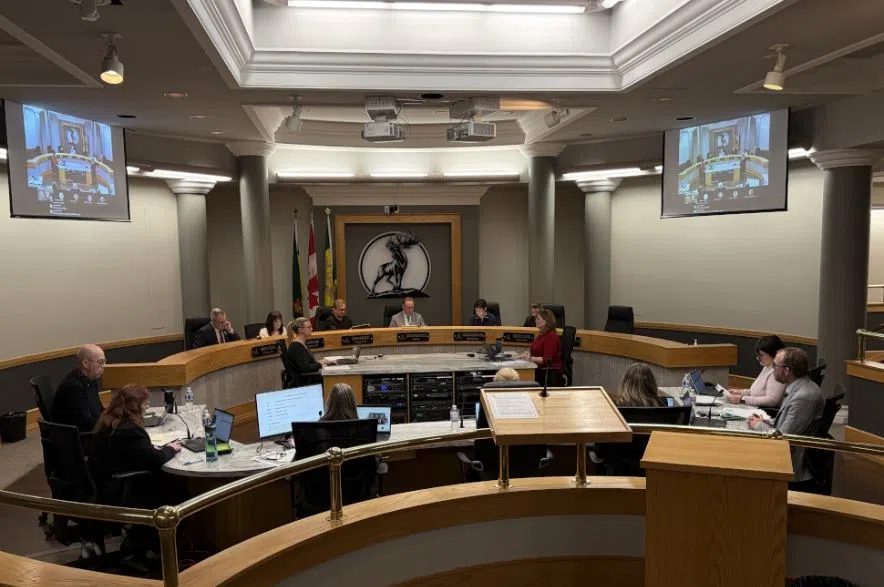
Moose Jaw City Council unanimously passed its 2026 operating and capital budget on Monday night, approving a 6.95 per cent mill rate increase.
The hike includes a 3.98 per cent increase for the Moose Jaw Police Service and a 2.97 per cent increase for the city’s operating budget.
Read more:
Council also approved four per cent increases to both waterworks utility rates and sanitary sewer utility rates.
The waterworks infrastructure levy will remain at $100 per taxable property, except for multi-unit residential buildings, where the levy will be charged to each dwelling unit.
The parks and recreation infrastructure levy will also remain at $65 per taxable property, with multi-unit residential buildings again charged per unit.
“I feel as good as possible that the number came in under that three per cent — 2.97 per cent strictly for the mill rate — and we know it’s 3.98 per cent for the police budget,” Mayor James Murdock said.
The mill rate increase means the average homeowner will pay $139.70 more in 2026, or about $11.64 per month. The increase is expected to generate $2.845 million in revenue.
The four per cent increases to waterworks and sanitary sewer utilities will add about $1.64 per month, or $55.68 per year, for the average customer.
Coun. Heather Eby said it was the utility increases — not the mill rate — that concerned her most.
“I’ll really look forward to the day when we don’t have to increase waterworks and sanitary rates. I know why we’re doing it — we still have huge infrastructure costs — but those ones bother me more than the mill rate,” she said.
Coun. Chris Warren explored additional options to reduce the mill rate before the budget vote.
Earlier in deliberations, council received a report outlining strong returns in the city’s investment portfolios. Based on that, Warren moved to draw down an additional $409,756 in investment earnings for the 2026 operating budget — the equivalent of a one per cent mill rate reduction.
Director of Financial Services Jaime Ansell cautioned against the move.
“When we use investment earnings to fund operational activities, it’s not recommended — even by our investment broker,” she said.
Other councillors raised concerns about the volatility of the investment market and the risk of relying on returns that may not materialize.
Eby added that using investment earnings would only provide a one-year fix.
“If we were to pull out any extra investment earnings this year or another year, I’d prefer it go to a specific project,” she said.
Warren argued council had already set a precedent for reducing costs by deferring expenses.
“This is a concept that has been — and is — accepted by council,” he said. “Our investment portfolio performed exceptionally well in 2025. Those are unrealized gains sitting there, and if we lose a couple of million dollars next year, then there’s no chance to use that funding to benefit our community.”
The motion was defeated 5–2, with Warren and Murdock voting in favour. Murdock later said he supported the idea because the funding could have helped pay for projects such as road work.
Warren also moved to cap annual funding to the equipment reserve at $4.5 million starting in 2027, and to cap total funding from 2026 to 2030 at $22.5 million. The intent was to slow rapidly increasing reserve costs.
He noted that according to the city’s 2024 audited financial report, equipment makes up 15 per cent of the city’s asset base. However, in the 2026 capital budget, equipment represents 42 per cent of asset-related funding.
He also pointed out that the equipment reserve is projected to grow from $4.987 million in 2026 to $9.6 million by 2030.
“For a city the size of Moose Jaw, I don’t believe that’s sustainable,” he said. “Our expenditures are outpacing revenue and growth, and one of our budget principles says we must live within our means.”
Fire Chief Rod Montgomery warned that capping the reserve could jeopardize essential purchases — including a $3.3-million ladder truck scheduled for 2030, already delayed five years.
“The idea behind the equipment reserve is so those items are never underfunded,” he said. “You’ll paint yourself into a corner where you’re choosing between a fire truck, three garbage trucks or laying off 10 people — because the money has to come from somewhere.”
Most councillors agreed the proposal amounted to a major policy shift requiring more analysis.
“I really feel this relates to policy, and I’m not comfortable making a change of this magnitude on the fly — sitting here saying ‘we think this’ or ‘we don’t know that’ with no real understanding of the impacts,” Eby said.
Coun. Kim Boyle moved to refer Warren’s proposal to administration for a report in 2026. The motion passed unanimously.