

Murray Wood: The fascinating phenomenon of people's laps
Who knew one's lap was so interesting? Murray Wood wonders: Do those folks really think we don't know they're texting be...
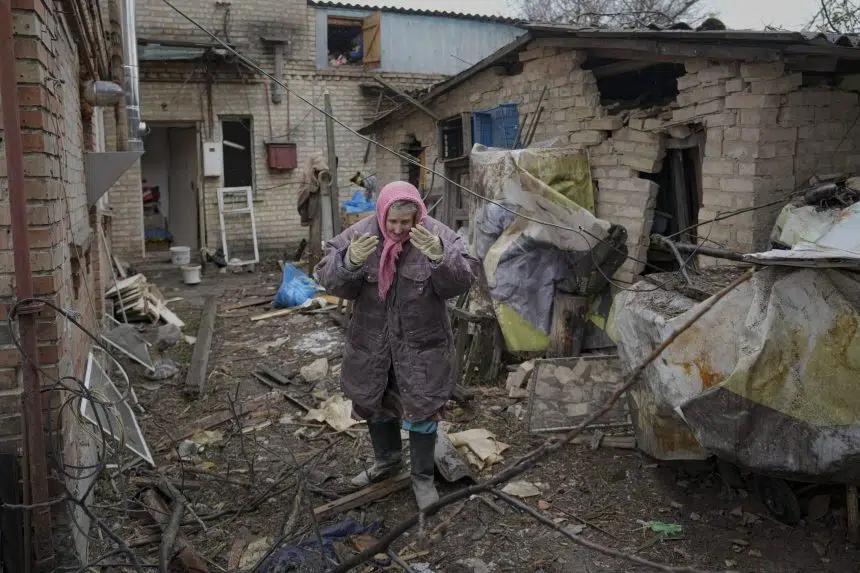
The videos, images and stories coming out of Ukraine are heartbreaking: Videos of the aftermath of bombings, children hiding in bomb shelters, and refugees huddled together waiting for news from home.
Danylo Puderak, the executive director of the Ukrainian Canadian Congress of Saskatchewan, calls it a humanitarian crisis.
“When we watch the news, we see just the horror that so many Ukrainians are now experiencing in their homes, in their cities (and) in their towns, but the reality is that it will get worse before it gets better,” said Puderak.
He said his family in Ukraine is all right but his staff at the congress have family there as well.
“Most of them are from Ukraine themselves and have parents, grandparents (and) siblings that are there and that are hearing those bombs (and) that are hiding in the bomb shelters. And I feel so much for them,” Puderak said.
“The emotions are raw and I can’t imagine what it would be like knowing that something so terrible could happen to your family members at any moment.”
The people in Ukraine need help and Puderak said the easiest way for people in Saskatchewan to help is with donations.
The Rawlco Radio Saskatchewan Day of Caring for Ukraine on Thursday is meant to help raise funds for those fleeing and those still in Ukraine.
The Day of Caring runs from 6 a.m. to 6 p.m., and all the money raised goes to the Ukraine Humanitarian Appeal, a joint effort by the Ukrainian Canadian Congress and the Canada-Ukraine Foundation.
For information on how to donate, click here.
“With funds like the Ukraine Humanitarian Appeal, they are getting aid right into Ukraine. They have, for example, a partnership arrangement with a charitable agency that has six warehouses throughout the country where the aid is getting to and is being distributed from there to the people that need it,” said Puderak.
People in Ukraine need food, shelter, and medical supplies – not just for people but hospitals as well.
Puderak is grateful to the people of Saskatchewan. He said the congress has been inundated with phone calls from people offering financial assistance, homes for potential refugees, and items they could donate.
He said in the not-too-distant future, we could be seeing the arrival of refugees from Ukraine, and they’ll be calling on the people of Saskatchewan to help then too.
Olena Shyian has lived in Regina for 15 years, but she’s from the village of Hora, Ukraine. It borders the Boryspil International Airport, which was bombed and seized by Russian forces during the early stages of the invasion.
Shyian’s sister, mother and extended family members still live there.
It has been a shocking, terrifying and anxious time for her.
She has been able to speak with her sister and mother, as they’re still able to connect to the internet. However, it’s not always stable, and that has led to some very scary moments.
“The other extended family, I couldn’t connect with some of them for over 24-hours. That was just … really scary because I knew that their town was bombed. Lots of missiles and everything — that’s what the news (was) showing and I couldn’t connect with them,” she said.
“I was losing my mind.”
Luckily, they’re safe right now, but Shyian said their houses are “pretty much destroyed.”
For her mother, sister and aunt, they live every night in fear and discomfort. To shield themselves from potential bombs, they have to hide in the basement.
“They have an old cellar, which was not really built well,” Shyian said, her voice choked with emotion. “There is no railings there. That’s where they’re hiding pretty much every night. It’s been really difficult for them to carry my mom’s sister down there, because it’s not set up for people with limited mobility.”
She said that for her large extended family, it’s a mix of hiding to stay safe, and putting all hands on deck to help Ukraine battle back against the Russian attackers.
“A lot of men went and they registered, if not with the official forces, then they’re set up to guard and protect the territory where they’re living … or working with (people) providing food and organizing stuff there,” she explained.
“Pretty much everybody is busy doing something, and united and organized so that they can stand together.”
In such a dangerous and scary environment, will her family consider joining the hundreds of thousands of refugees who have fled to nearby countries like Poland or Slovakia?
She replied no — not after all the blood, sweat and tears put into their homeland.
“For our family, and for many other Ukrainians, when they are working so hard and building their house, then that’s all that they have,” Shyian said.
“They say that … there is no place better than their own house and their own land. They said that they’re going to stay at home, and they’re not going to go anywhere.”
Shyian works as a kindergarten teacher.
She had a very emotional moment explaining the war to her class, using a biblical reference that many have used to compare Russia’s military might with Ukraine’s much smaller pool of resources.
“I showed them a bible story about David and Goliath. Then I showed them the map of Ukraine and Russia and I said, ‘Do you see any similarities there?’ Then my students said yes. And then I asked them to pray that the ending in our story is exactly the same,” she said in a voice thick with emotion.
“It’s amazing how five-year-olds can understand what’s happening, and how sincere their prayers are.”